
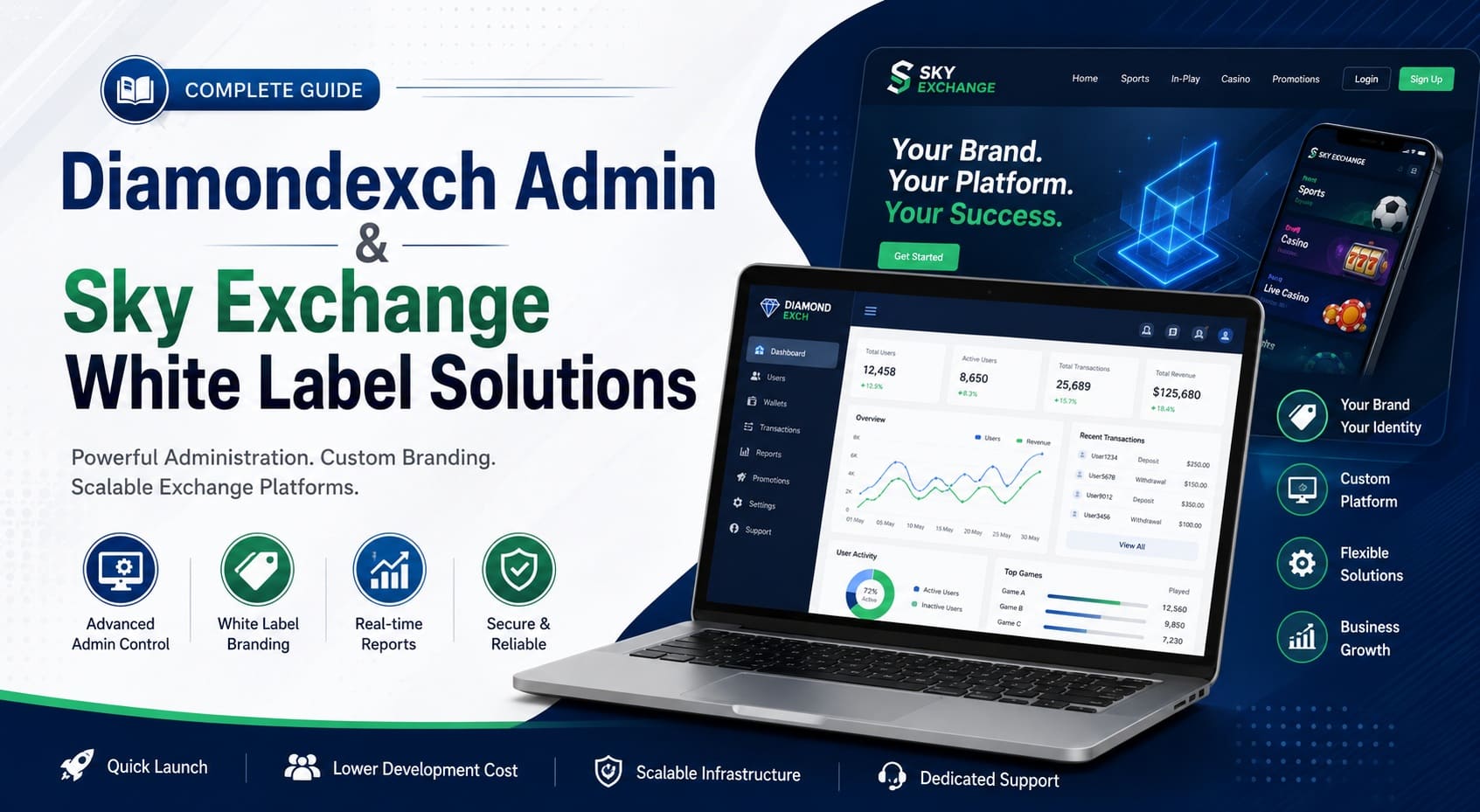
The online exchange and digital gaming industry has evolved rapidly, with businesses increasingly looking for flexible technology solutions that can be customized to their own brand and operational requirements. Instead of developing an entire platform from scratch, many operators explore ready-to-deploy technologies that provide essential management tools, customization options, and scalable infrastructure.
Two terms that frequently appear in this space are diamondexch admin and sky exchange white label solutions. While they represent different aspects of an exchange platform ecosystem, understanding how administrative management and white-label technology work together can help businesses make more informed technology decisions.
What Is an Exchange Platform?
An online exchange platform is a technology system that allows users to access exchange-related services through a web or mobile interface. Behind the user-facing website is an administrative system responsible for managing accounts, platform settings, transactions, content, reports, and other operational functions.
For an operator, the administrative dashboard is particularly important because it provides centralized control over the platform. A well-designed backend should make routine management easier while providing appropriate controls for monitoring activity and maintaining operational efficiency.
Understanding the Role of a Diamondexch Admin
The term diamondexch admin generally refers to the administrative side of the Diamondexch platform environment. An administrator dashboard can serve as the central control panel through which authorized operators manage different aspects of their platform.
Depending on the implementation, administrative functionality may include user management, account monitoring, transaction oversight, reporting, platform configuration, and content management. Access permissions can also be separated between different staff members so that sensitive functions are available only to authorized personnel.
A professional administration system should focus on usability as well as security. Clear navigation, organized reporting, role-based access, authentication controls, and activity monitoring can make it easier for administrators to operate a platform efficiently.
What Are Sky Exchange White Label Solutions?
Sky Exchange white label solutions refer to a technology approach in which an existing exchange platform infrastructure can be customized and presented under another business’s branding.
Rather than building every component independently, a business can use a white-label solution as a technological foundation and customize elements such as branding, domain configuration, interface design, user experience, and selected platform features.
This approach can significantly reduce development requirements compared with creating a complete exchange platform from the ground up. It can also allow businesses to concentrate more heavily on branding, customer experience, marketing, and operational processes.
How White Label Platforms Work
A typical white-label model separates the underlying technology from the public-facing brand.
The technology provider manages or supplies the core platform, while the business using the solution can customize the presentation according to its requirements. Depending on the provider and package, customization may cover the website interface, logos, colors, domain, account structure, reporting tools, and administrative functionality.
This creates a model where businesses can launch a branded digital platform without having to develop every technical component themselves.
However, white-label technology should not be viewed simply as a shortcut to launching a website. The quality of the underlying infrastructure, security architecture, scalability, support, customization capabilities, and compliance framework should all be evaluated before selecting a provider.
Benefits of Using a White Label Exchange Solution
One of the biggest advantages of a white-label platform is reduced development time. Building a sophisticated exchange system from scratch requires considerable investment in software development, infrastructure, testing, security, maintenance, and ongoing updates.
A ready-made solution can provide an established technological foundation while allowing businesses to focus on their own brand and customer-facing experience.
Another advantage is scalability. A properly designed platform can be expanded as the user base and operational requirements grow. Businesses can also benefit from centralized administrative tools that simplify everyday platform management.
Customization is another important consideration. A good white-label solution should provide sufficient flexibility to create a distinctive user experience rather than forcing every business to use an identical interface.
Administrative Management Is Just as Important as the Frontend
A visually attractive website is only one part of a successful digital platform. The backend administration system plays an equally important role.
Administrators may need to monitor user activity, manage accounts, review reports, configure platform settings, handle support requests, and oversee transactions. These processes become increasingly difficult when the backend is poorly organized.
For this reason, businesses evaluating an exchange technology solution should examine both the public-facing interface and the administrative dashboard. A powerful backend can improve operational efficiency and provide better visibility into platform activity.
What to Consider Before Choosing a White Label Provider
Businesses should evaluate several technical and operational factors before selecting a white-label technology provider.
First, examine the platform’s security architecture. User information, authentication systems, administrative access, and transaction-related data should be protected through appropriate security measures.
Second, consider customization capabilities. The solution should support the branding and user experience requirements of the business rather than providing only superficial visual changes.
Third, evaluate scalability and infrastructure. A platform that performs well with a small number of users should also have an appropriate architecture for future growth.
Technical support is another important factor. Regular updates, maintenance, troubleshooting, and infrastructure assistance can become essential as the platform develops.
Finally, businesses should understand the legal and regulatory requirements applicable to their target market. Technology providers and operators should ensure that their implementation complies with relevant laws, licensing requirements, responsible-use standards, data-protection obligations, and payment regulations.
White Label vs. Custom Development
The choice between white-label technology and completely custom development depends largely on the business’s objectives.
Custom development provides maximum control over architecture, functionality, integrations, and user experience. However, it generally requires more time, development resources, testing, maintenance, and investment.
White-label technology can provide a faster starting point with an existing infrastructure and established features. The trade-off is that customization may be limited by the underlying platform and provider.
For businesses looking to establish a branded exchange platform without developing every component independently, a carefully selected white-label solution can therefore be a practical technology strategy.
Building a Stronger Platform Through Technology and Management
The combination of reliable technology and effective administration is critical for long-term platform performance. While the frontend determines how users interact with the service, the backend determines how efficiently the business can manage it.
Solutions associated with platforms such as Diamondexch and Sky Exchange demonstrate the broader trend toward modular and customizable exchange technology. Businesses can use these approaches to reduce development complexity while creating an experience tailored to their own brand.
The key is to evaluate the technology beyond its appearance. Security, scalability, administrative controls, customization, support, infrastructure, and compliance should all be considered before making a technology decision.
Final Thoughts
The growing demand for flexible digital platforms has increased interest in white-label technology and centralized administration systems. A well-designed administrative environment can simplify day-to-day operations, while a robust white-label solution can provide the technical foundation needed for a customized digital experience.
Whether a business is researching a diamondexch admin environment or comparing sky exchange white label solutions, the most important consideration is not simply how quickly a platform can be launched. Long-term reliability, security, scalability, customization, technical support, and regulatory compliance should all form part of the evaluation process.
Choosing technology based on these factors can help businesses establish a more dependable platform and create a better foundation for future growth.
Frequently Asked Questions
What is a Diamondexch admin panel?
A Diamondexch admin panel refers to the backend management environment used by authorized administrators to manage platform operations, accounts, settings, reports, and other administrative functions.
What are Sky Exchange white label solutions?
Sky Exchange white label solutions are technology offerings based on a pre-existing platform that can potentially be customized with a business’s own branding, interface, domain, and selected functionality, depending on the provider.
Why do businesses choose white-label technology?
White-label technology can reduce development time and provide an established technical foundation. It allows businesses to focus more on branding, customer experience, operations, and other areas instead of developing every platform component independently.
Is a white-label platform customizable?
Customization depends on the technology provider. Depending on the solution, businesses may be able to customize branding, interface elements, domains, account structures, and selected functionality.
What should businesses check before selecting a white-label solution?
Businesses should evaluate security, scalability, customization, infrastructure, technical support, integrations, maintenance, data protection, and applicable legal and regulatory requirements before selecting a provider.